Cordango Was Not Built in Ten Weeks
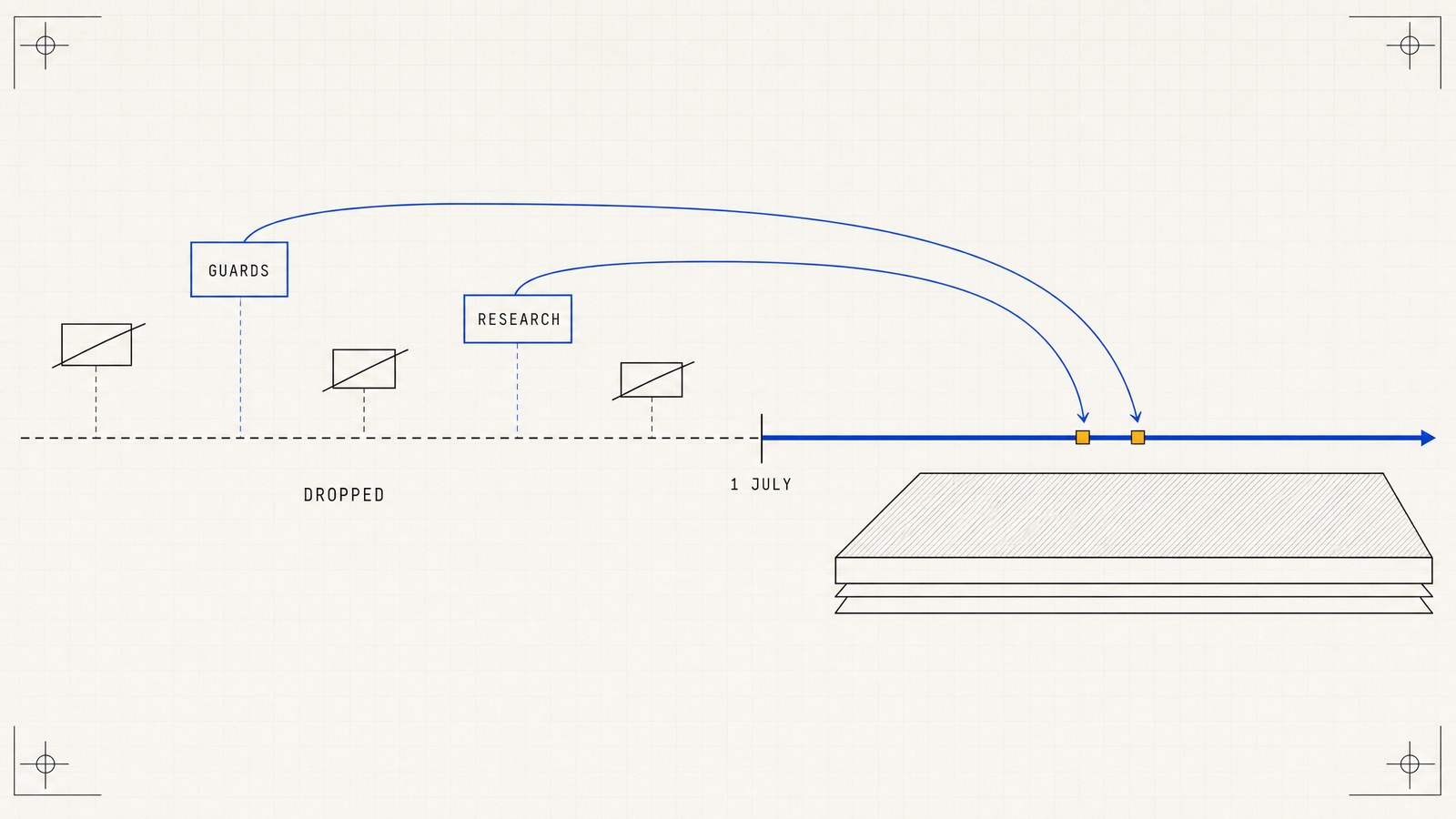
The first commit in this repository is dated 1 July 2026. The message is "Create readme.md". Ten weeks and 192 commits later there is a hosted platform, an open source compiler, a command line tool you can install through Homebrew, and companies with real data in a beta.
We wrote about this in August, after somebody read the dates on our GitHub organisation and concluded we had started that week. It still happens. Somebody sees a young repository next to a working product and fills the gap with a story about speed.
The git history is honest about when we started typing. It says nothing about when we started.
What was already sitting there on 1 July
Four things went into Cordango that were not built for Cordango. The oldest of them is four years older than the company.
That one is not really ours either, in the sense that it predates any "we", so this is the paragraph where I drop the company voice. net-dynamic-api went up on my personal GitHub in March 2022 under an MIT licence, and it does one thing. You hand it a model and it hands you back a working API, entities and endpoints and persistence wired up for you. It collected 194 stars and I stopped touching it in early 2023. Parts of that library are in the standalone runtime today, which is what you get when you run cordango build and walk off with an application you host yourself. A definition goes in and a running API comes out. That is the whole shape of Cordango, four years early and a great deal smaller.
Rasepi started as evening work in the middle of 2024 and only ran as a real project from October 2025 to February 2026. It was a testbed for one idea: a record should carry its own rules. What you are permitted to do with a customer record is part of that record's definition, not a check every application has to remember to perform on its own. That is an unglamorous thing to spend two years of evenings on. It is also the reason permissions in Cordango sit underneath every app rather than being rebuilt inside each one, which is the single design decision the rest of the platform hangs off.
Smoower was built in the same stretch as a developer relations tool. Work out which companies and which people are worth a conversation, and know something real about them before getting in touch. Almost everything it learned about researching a company from its own public pages, what is worth reading, what is worth believing, how to show where a fact came from, is now the research module inside Organizations.
The most recent borrowing is only months old, which surprised us when we went back and checked. AdaptiveAPI went up in April 2026 as a drop-in proxy that makes an API, an MCP server or a model answer in more than one language. Parts of it run inside Cordango now. Eleven weeks between that repository and the first commit here.
There were several other concepts across those months. They do not get links, because there is nothing to link to.
Here is the part we would rather skip. At the time, we did not experience any of that as groundwork. Rasepi was supposed to be a product. It was not filed under "useful research for the thing we will build next year", it was filed under "that did not work". The reframe came afterwards, and reframes that come afterwards are cheap. Anyone telling you they knew the failures were investments while they were failing is telling you a story they wrote later.
Everyone's timeline is wrong in the same direction
The pattern is so common it is almost rude to keep being surprised by it.
Slack is the one people quote. Tiny Speck spent years and a lot of money on Glitch, a browser game that launched in September 2011, went back into beta two months later, and shut down in December 2012. What survived was the internal chat tool the team had built for themselves while making it. What people leave out of that story is that it was Stewart Butterfield's second time doing exactly this. The first game, Game Neverending, also failed, and the photo-sharing feature inside it became Flickr.
DeepL did not appear in 2017 with a better translation model. Linguee was founded in 2009 by Gereon Frahling and Leonard Fink and spent most of a decade building a bilingual corpus as a dictionary business. DeepL launched on 28 August 2017 on top of that data. The product that looked like magic was eight years of unglamorous data work with a neural network put on the end.
Notion is the harshest version. In 2015 Ivan Zhao and Simon Last laid off their employees, sublet the San Francisco office, moved to Kyoto to cut costs, and rewrote the thing from scratch, kept alive partly by a bridge loan from Zhao's mother. Notion 1.0 shipped in March 2016, three years after they started. The company most people think of as an overnight productivity story was nearly dead before the version anyone remembers existed.
And Lovable, which is recent enough that the receipts are still on GitHub. Anton Osika published GPT Engineer as open source in 2023, then he and Fabian Hedin built a commercial version called GPT Engineer App, and the thing only really worked after they renamed it Lovable in December 2024. Three names before the product landed.
You already know the Instagram one. Burbn, a cluttered check-in app, everything stripped out except photos and comments. It gets quoted so often it has stopped meaning anything, which is a shame, because the mechanism underneath it is the same as all the others.
The part that actually transfers
We used to think the reusable asset from a dead project was the code. Some of it is, and we did lift real code out of Rasepi. But the code is the smaller half.
The bigger half is the list of things you now refuse to do. We will not let an application hold its own copy of who is allowed to do what, because we watched what that costs. We will not model people separately per app, because we did that and then spent a week reconciling three addresses for the same person. Those are not insights. They are scar tissue, and you cannot read your way to them.
That is also our honest answer to the uncomfortable question, which is whether any of this is a moat when a model can write an app from a sentence. The generation is not the hard part, and in September we counted what is. The hard part is the shared core underneath: one identity, one permission model, one audit trail, one set of People and Organizations that every app agrees on. You do not get to that in ten weeks. You get to it by building the wrong version of it two or three times first, in evenings, on somebody else's dime, under a different name.
If you are in the middle of one
We are not going to pretend there is a reliable formula here. Plenty of failed projects are just failed projects, and survivorship bias is doing a lot of work in every story above, including ours. Cordango could still be the next entry on the list of concepts that got dropped.
What we would say is narrower. When something you built does not become a business, go and write down the one mechanism inside it that did work before you close the repository. For us that was six words, roughly "the rule travels with the data". Two years later it is the thing the whole platform stands on.
The roadmap page has the full version of this, month by month, including the parts that got thrown away. And if you want to see what the scar tissue turned into, join the beta and bring the process in your company that currently lives in three tools and a spreadsheet.
See Cordango in your own company
The fastest way to understand it is to watch it stand up a company and add an app live.
Join the beta →Related posts
Why We Have AI Write YAML Instead of Code
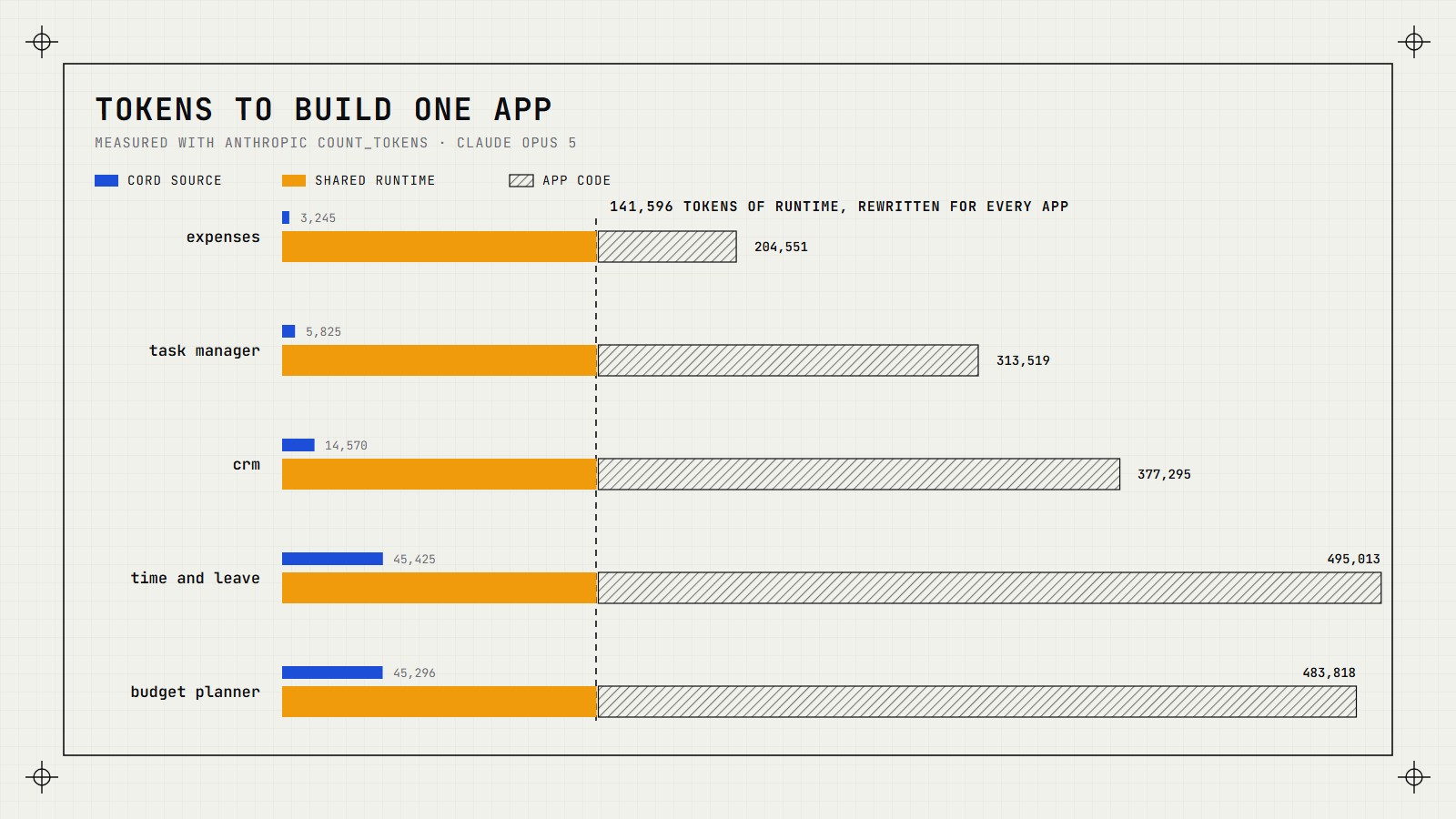
We finally counted, on Anthropic's own tokeniser. Describing our expenses app takes 3,245 tokens. Building the same thing from an empty folder takes 204,551. Here is where the difference goes, and why the saving is still not really about typing.
Read →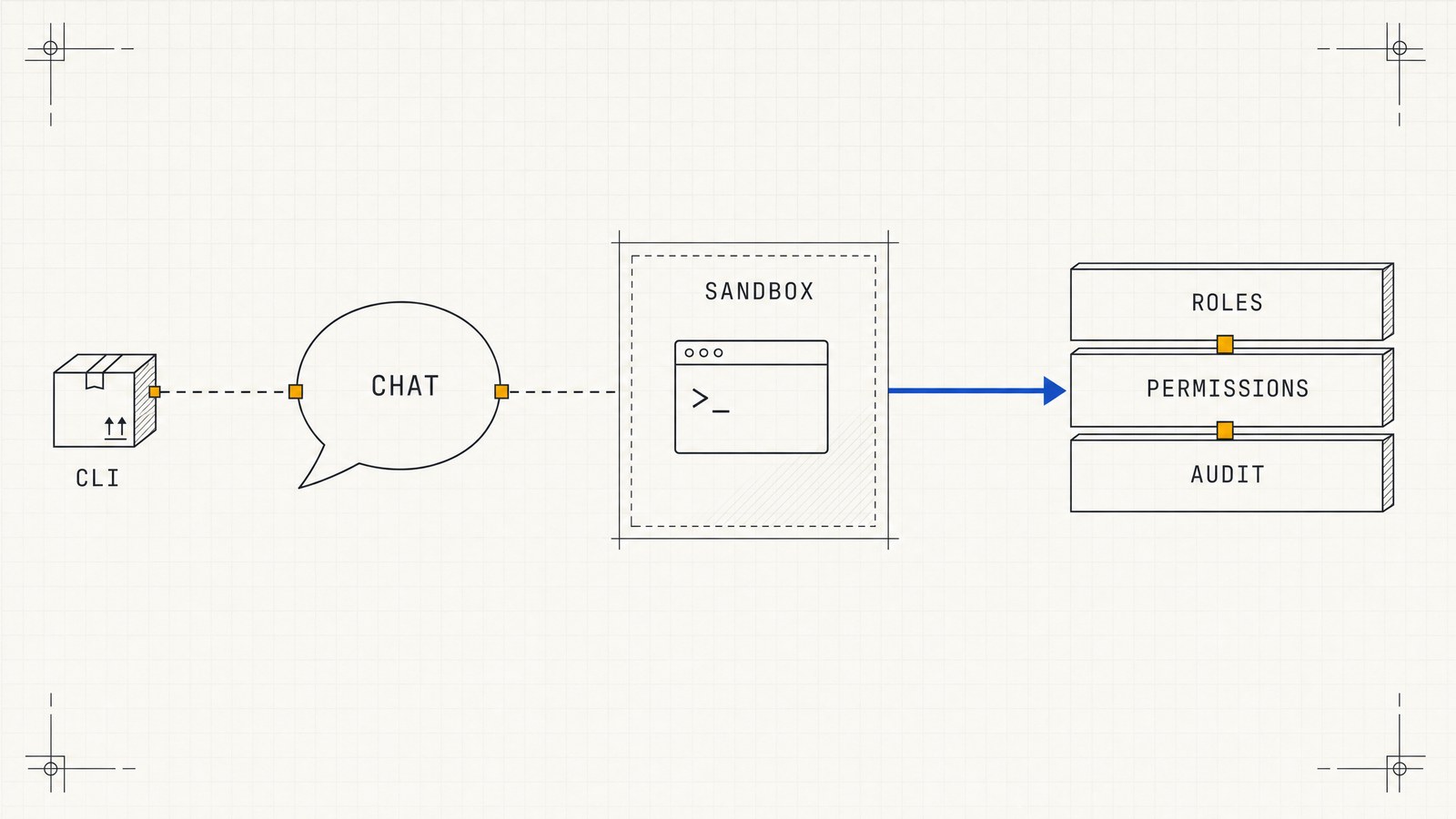
We Gave ChatGPT a Command Line and It Built a Real Time Tracking App
ChatGPT cannot install our command line by itself. Hand it the Linux package and it can. It wrote a German working time app, argued with the compiler until the app passed, and published it to the platform while we watched.
Read →