The GitHub organisation is dated 20 August 2026. That is the day the open core left the private repository. It is not the day the work started. Below is the record, and after it, what we are building now.
Month by month, with the milestones inside each one. The orange marks are the periods that changed the direction of the product.
BEFORE
Where it comes from
2024
The idea
Cordango started as a complaint about buying the eleventh piece of software and entering the same twenty-four people into it for the eleventh time. There was about two years of arguing about that before anybody wrote a line of code.
October 2025 to February 2026
Concepts built, and mostly thrown away
A run of experiments about how business data ought to behave, none of it called Cordango yet. Rasepi was one of them: a testbed for keeping records behind action guards, where what you are permitted to do with a record is part of the record’s own definition rather than something every application has to remember to check for itself. Several other concepts were built and dropped in the same stretch. The guard idea is the one that survived, and it is why permissions in Cordango sit underneath every app instead of being rebuilt inside each one.
Rasepi, records kept behind action guards
The rule travels with the data, not with the app
Several concepts built and abandoned
Alongside
Smoower, and where the company research came from
Smoower was built as a developer relations tool: work out which companies and which people are worth talking to, and know something real about them before getting in touch. Nearly everything it learned about researching a company from its own public pages, what is worth reading, what is worth trusting and how to show where a fact came from, is now the research module inside Organizations.
Built as a developer relations tool
Researching a company from its own public pages
Now the research module inside Organizations
2026
Building it
June 2026
Finding out whether it could work at all
June was about the AI rather than about the product. One shot against step by step. Model against model on the same task, to see which could hold a large structured document together without drifting halfway through it. And then the question the whole idea rested on: can a description become an entire application, with its data, its rules, its workflows, its permissions and its screens, as one structured document? Or does that fall apart the moment the app gets complicated? It did not fall apart.
One shot against step by step
Model against model, same task, measured
A whole application as one structured document
July 2026
The experiments and the earlier products become a product
The first working application landed in the first days of the month, and then everything a working application actually needs: storage that survives a restart, a workspace to open it in, real companies and real people, and permission that means something. Apps learned to calculate. Twelve complete example apps were hand-built on one fictional company, which found more missing capabilities than any generated app ever did.
2 July, the first application that ran
12 July, an app can be handed to a team, with roles enforced down to the field
22 July, apps can calculate
22 July, twelve complete example apps on one demo company
30 July, companies and people move into the platform itself
THE NAME6 July 2026
It becomes Cordango
Naming it took a week and produced mostly dead ends. Every real word worth having was already gone: sixteen candidates out of sixteen were taken on .com, on .io and on GitHub. The obvious roots were worse than useless, because a name that literally means company lands in the most crowded corner of business software there is. Two finalists went through full checks and both had to be dropped, one of them the best-sounding of the lot. Cordango was free on every domain and every handle, and it was secured the same morning it was chosen.
Sixteen real words tried, sixteen already taken
Two finalists dropped after the legal checks
cordango.com and the GitHub organisation secured within hours
25 July, the rename reaches the product itself
August 2026
From a platform to a product you can take with you
Every workspace got its own address, on a path that keeps everything inside Germany. It started working on a phone. Building an app stopped being a handle you pull once and became a conversation you steer. And then the part that mattered most: an app stopped being something that only lives here. It became files you own in your own repository, and then a conventional application you can host anywhere, with an API and an agent endpoint of its own.
7 August, one address per workspace, on a Germany-only path
9 August, it works on a phone
11 August, building an app becomes a conversation you steer
13 August, your app becomes files you own
21 August, applications you own outright and can host anywhere
23 August, every generated app serves an API and an endpoint AI agents can use
24 August, exported apps get a design, an admin area and a second user
OPEN SOURCE20 to 23 August 2026
The core goes public, under Apache-2.0
The compiler and the command-line tool moved out of the private repository into public ones of their own, where the test suite passes from a fresh clone with none of the platform above it. Three days later anybody could install it in a single line, through Homebrew or Scoop, with the full documentation online the same day, so the first person to install it had something to read. The line between what is open and what is not was drawn by job rather than by feature: everything you need in order to write an app and check it is open, which is why cordango check runs on a laptop with no account and no connection. Apache-2.0 cannot be taken back, so anything meant to stay closed had to land closed the first time.
20 August, the open core leaves the private repository
Dante, and a logo that stopped being a placeholder
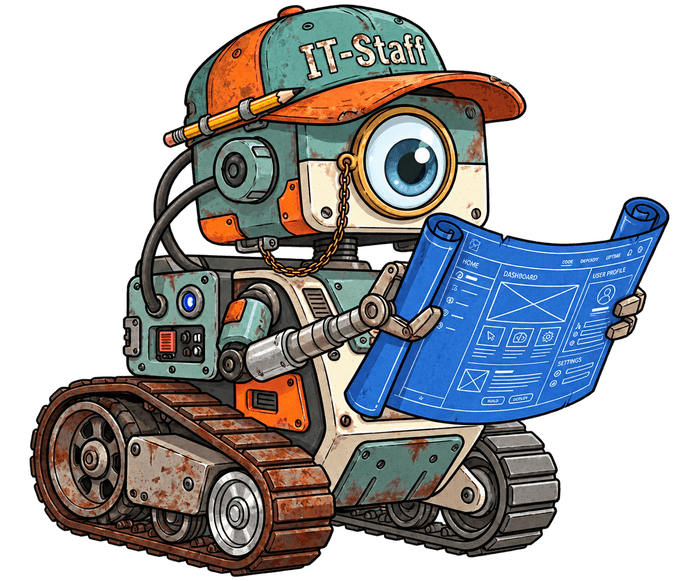
An assistant that builds an app with you is a hard thing to talk about in the abstract, so it got a face. Dante is the avatar for the thing you are actually talking to, and the mascot for everything around it. He turned out to belong in the logo as well: the work-in-progress wordmark that had been standing since July was replaced by the one with him in it. He also holds the empty page when a link goes nowhere, which is the honest place for a robot to be standing.
An avatar for the assistant, a mascot for the rest
Into the logomark, replacing the work-in-progress logo
And the one holding the empty page on a broken link
CCORDANGO
July, work in progress
↓
23 August, with Dante in it
Two months of shipping, and everything before it that made those two months possible.
FIG.02
What we are building right now
— in flight
Weeks, not quarters. Most of this is in somebody’s working tree today.
NOW
Your own fields on companies and people
The shared records are fixed today so that every app agrees on them. Next you will be able to add the fields your business tracks without giving that up.
NOW
Building an app, connected end to end
The conversation runs against your live workspace with a preview of your actual app beside it, in your language, and it survives you closing the tab.
NOW
Full behaviour in the apps you export
An app you take away carries its automations, calculations, rules and notifications, not only its screens and its data.
NOW
Forms for people outside your company
A link you send to a customer or an applicant that opens a real page they can fill in without an account.
NOW
Large models, at speed
Planning models with thousands of derived rows, and imports of hundreds of records, in seconds rather than minutes.
NOW
Connections to the tools you already run
Automation through n8n, which reaches the hundreds of services it already speaks to, and Microsoft 365 and Google for documents, calendar and email. Your files and your mail stay where they are and Cordango works with them, rather than asking you to move everything first.
NOW
Bring the people and customers you already have
Your existing lists, in from a spreadsheet or straight out of the systems they already live in, without anybody retyping them.
FIG.03
What comes after that
— scoped and queued
In roughly this order, and the order is not sacred.
NEXT
Guest access to a single app
Invite somebody from outside into exactly one app, and nothing else in the workspace.
NEXT
Run it on your own machine
A single install that runs Cordango locally, with nothing else to set up first.
NEXT
Changes flow back into your files
An edit somebody makes in the product comes back down into the Git repository you own, so the two never drift.
NEXT
Adjust an app you brought in
Change an imported app screen by screen instead of replacing the whole thing.
NEXT
Apps in more than one language
Field labels, screen titles and help text translated per app, not only the product around them.
NEXT
More shared company data
More of what every company has in common lives once at the platform level, so fewer apps need to be told about it at all.
NEXT
Ask your company a question
The search box answers questions about your apps and your data instead of only finding things by name.
NEXT
Company research that keeps itself current
Today you press Research now on a company. Next, profiles stay current on their own and tell you when something changed.
NEXT
Connections you can test before you trust them
Save an integration and confirm it actually works before an app starts depending on it.
NEXT
Rearrange a page by dragging
Move blocks around your own pages by hand, not only with the buttons.
FIG.04
Known, wanted, not yet scoped
— on the list
We know we want these. We have not decided how or when, and we are not going to pretend otherwise.
LATER
Documents inside your apps
Contracts, offers and specifications living beside the records they belong to, with the same permissions and the same history.
LATER
Answers out of your own documents
Ask a question and get an answer grounded in what your company has actually written down.
LATER
Sign in with your company account
Staff use the account they already have, and joiners and leavers are handled where you already handle them.
LATER
On your phone, as an app
An icon on the home screen and notifications, rather than a browser tab.
LATER
Apps that react to each other
Something happening in one app can start work in another. Apps already announce what they did; this is delivering it.
LATER
Rules about whose records are whose
Say that reps see only their own deals, as a rule the system enforces rather than a habit everyone remembers.
LATER
Apps that arrive already set up
A new app opens with sensible starting values in it rather than with somebody hand-writing forty setup steps first.
NEXT
Something here you actually need?
The order is not fixed. If one of these is the thing standing between you and using Cordango, say so and it moves up. That is a large part of how this list gets ordered in the first place.